



Meta Ads for Beginners: A Step-by-Step Guide ,Meta Ads are a popular way for businesses to promote their products, services, websites, offers, and content on platforms such as Facebook and Instagram.
Unlike organic posts, paid advertising allows businesses to reach specific audiences based on factors such as location, interests, and previous interactions.
For beginners, Meta Ads may seem complicated at first. Campaign objectives, audiences, budgets, ad creatives, placements, and performance metrics can feel like a lot to learn.
The good news is that you do not need to understand everything at once. By learning each concept step by step, Meta Ads can become much easier to understand.
Whether you are a student, freelancer, business owner, or digital marketing beginner, learning Meta Ads can help you understand how paid social media advertising works.
What Are Meta Ads?
Meta Ads are advertisements created through Meta’s advertising system. Businesses use them to reach potential customers while they are using social media.
A business can use Meta Ads to:
- Generate leads
- Promote products
- Increase website visits
- Receive customer enquiries
- Generate sales
- Promote special offers
- Build brand awareness
Simple Example
Imagine a coaching institute launching a new digital marketing course.
Instead of showing the advertisement to everyone, the institute can create a campaign aimed at people who may be interested in learning digital marketing.
Before creating any campaign, ask yourself:
What do I want people to do after seeing my advertisement?
The answer will help you decide how to structure your campaign.
Why Do Businesses Use Meta Ads?

People spend a lot of time on social media watching videos, browsing posts, discovering products, and interacting with businesses.
However, an organic post may not reach every potential customer.
Meta Ads give businesses another way to reach relevant audiences through paid advertising.
Businesses can use Meta Ads for:
- Launching new products
- Promoting services
- Generating enquiries
- Reaching local customers
- Driving website traffic
- Supporting online sales
- Promoting events
- Increasing brand visibility
For example, a local restaurant may want to reach people living nearby. An online store, on the other hand, may want to reach people interested in its products.
Think about your own business:
Do you want more website visitors, enquiries, phone calls, or purchases?
Knowing your goal can help you choose the right advertising approach.
How Do Meta Ads Work?
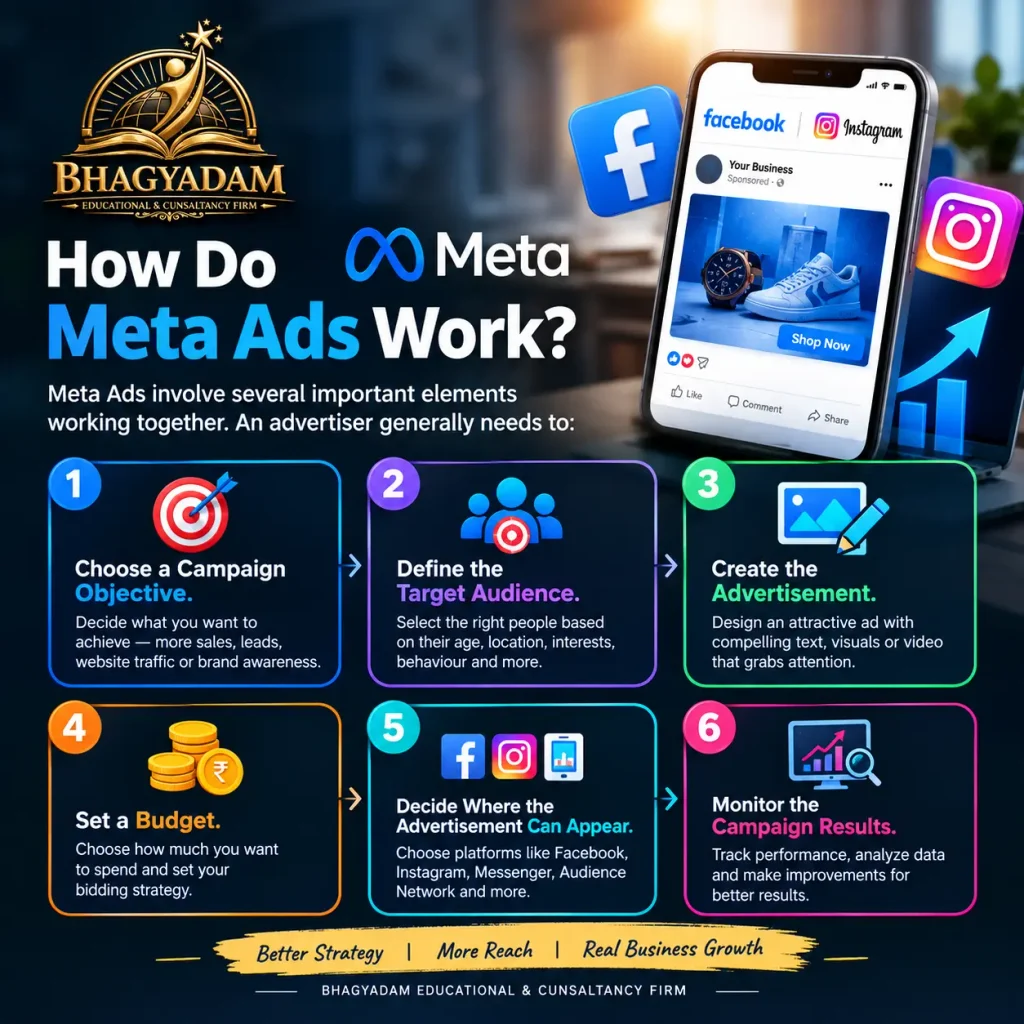
Meta Ads involve several important elements working together.
Meta Ads for Beginners: A Step-by-Step Guide
An advertiser generally needs to:
- Choose a campaign objective.
- Define the target audience.
- Create the advertisement.
- Set a budget.
- Decide where the advertisement can appear.
- Monitor the campaign results.
Meta’s system then uses available information and advertising signals to deliver eligible advertisements to users.
This means successful advertising is not simply about spending more money.
Your audience, advertisement, offer, and desired result should work together.
For example, if a photography business wants to promote wedding photography, the advertisement should communicate information that is relevant to people who may actually need that service.
What Is Audience Targeting?

Audience targeting helps advertisers decide who should be considered for their campaigns.
Depending on the campaign and available options, advertisers may consider:
- Location
- Age
- Interests
- Previous interactions
- Website activity
- Customer information
- Other available audience signals
Example
Imagine a dental clinic promoting a local dental service.
Showing the advertisement to people who live close enough to visit the clinic may make more sense than showing it to people who live in another city.
Ask yourself:
If you were promoting a local business, would you target everyone or focus on people who can realistically become customers?
The answer depends on the business, location, product, and campaign objective.
What Are Ad Creatives?
An ad creative is the visual and written content used in an advertisement.
It can include:
- Images
- Videos
- Headlines
- Primary text
- Product information
- Call-to-action elements
The creative is often the first thing users notice when they see an advertisement.
Imagine two businesses advertising the same product.
One advertisement uses an unclear image and a long paragraph. The other clearly shows the product and explains its main benefit in just a few words.
The second advertisement may be easier for people to understand.
Good creative does not always mean complicated design.
Clear and relevant content is often more useful than unnecessary decoration.
Why Is Ad Copy Important?
Images and videos can attract attention, but ad copy explains what the advertisement is actually offering.
Good ad copy should make the message easy to understand.
Before writing your copy, think about these questions:
- What is being offered?
- Who is it for?
- What problem does it solve?
- What should the viewer do next?
For example, instead of simply writing:
“Join Our Course Today”
an institute could explain what the course teaches and who the course is designed for.
The wording should always match the target audience and campaign objective.
What Are Meta Ads Campaign Objectives?
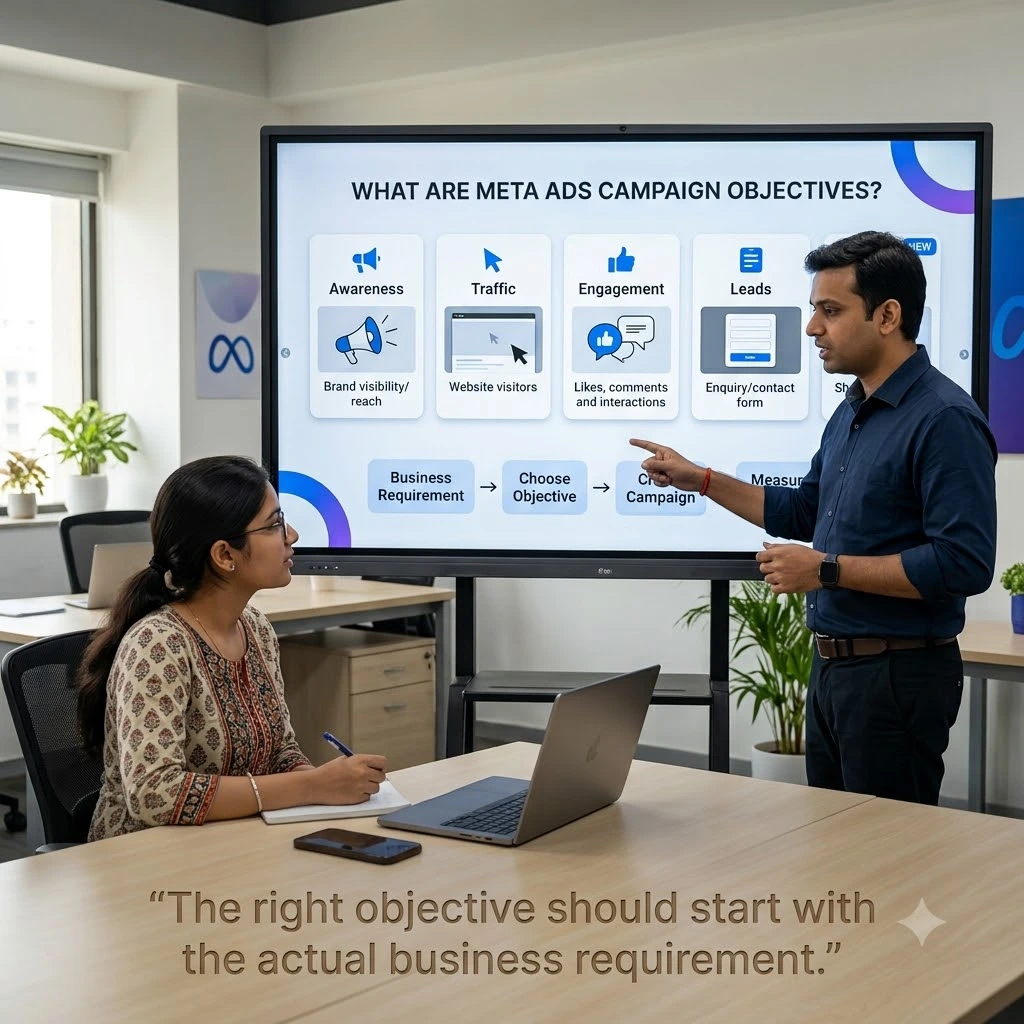
A campaign objective tells Meta what type of result an advertiser wants to work toward.
Meta Ads for Beginners: A Step-by-Step Guide
Depending on the available campaign options, businesses may focus on objectives such as:
- Awareness
- Traffic
- Engagement
- Leads
- Sales
The right objective should start with the actual business requirement.
For example, if a business wants customer enquiries, the campaign should be planned around generating that type of result.
Before creating a campaign, ask:
“What action would make this advertisement useful for my business?”
This question can help you focus on meaningful business results instead of only looking at views or likes.
What Is a Meta Ads Budget?
A budget is the amount an advertiser plans to spend on a campaign.
There is no single budget that works for every business.
A small local business may start with a controlled budget, while a larger company may have a different advertising capacity.
However, spending more money does not automatically make a campaign successful.
If your advertisement is reaching the wrong audience, simply increasing the budget may not solve the problem.
That is why advertisers should regularly monitor campaign results and make changes based on the available data.
How Do You Measure Meta Ads Performance?
One of the advantages of digital advertising is that advertisers can access information about campaign performance.
Depending on the campaign, you may monitor metrics such as:
- Reach
- Impressions
- Clicks
- Engagement
- Leads
- Purchases
- Cost per result
- Conversion rate
Example
Suppose your advertisement receives thousands of views but generates very few enquiries.
This could be a reason to review your:
- Audience
- Creative
- Offer
- Landing page
Remember:
High reach does not automatically mean strong business results.
The most useful metric depends on what your campaign is trying to achieve.
Why Is the Landing Page Important?
When an advertisement sends users to a website, the landing page becomes an important part of their experience.
Imagine clicking an advertisement for a digital marketing course and landing on a page where the course details are difficult to find.
You may leave without making an enquiry.
A useful landing page should:
- Match the advertisement
- Explain the offer clearly
- Work properly on mobile devices
- Provide important information
- Load smoothly
- Make the next action easy to understand
Think of it this way:
The advertisement creates interest, while the landing page helps the visitor decide what to do next.
Who Can Learn Meta Ads?
Meta Ads can be useful for people from different backgrounds, including:
- Students
- Graduates
- Freelancers
- Business owners
- Job seekers
- Marketing professionals
- Content creators
- Digital marketing beginners
For example, a freelancer may learn Meta Ads to offer advertising services to clients.
A business owner may learn Meta Ads to better understand advertising campaigns for their company.
A student may learn Meta Ads as part of their digital marketing education.
You do not need to understand everything on your first day.
Start with the fundamentals and improve your knowledge through practice.
How Should a Beginner Learn Meta Ads?
A step-by-step learning process can make Meta Ads easier to understand.
Step 1: Understand Organic and Paid Social Media
Learn the basic difference between organic content and paid advertising.
Step 2: Understand Your Audience
Learn who your potential customers are and what they may be interested in.
Step 3: Learn Campaign Objectives
Understand why different campaigns may focus on awareness, traffic, engagement, leads, or sales.
Step 4: Learn Audience Selection
Understand how advertisers can define and reach relevant audiences.
Step 5: Practise Creating Ad Creatives
Create simple images, videos, headlines, and ad copy.
Step 6: Understand Budgets
Learn how campaign budgets work and why spending should be monitored.
Step 7: Learn Performance Metrics
Understand important metrics such as reach, clicks, leads, purchases, and cost per result.
Step 8: Practise Analysing Results
Review campaign data and identify areas that may need improvement.
A simple learning cycle is:
Learn → Create → Test → Measure → Improve
Practical exercises can help beginners understand how different campaign decisions can affect results.
Frequently Asked Questions
Ans. Meta Ads are used to promote products, services, content, offers, and businesses through paid advertising across Meta’s platforms.
Ans. Yes. Beginners can start by learning the basic concepts of objectives, audiences, creatives, budgets, and performance measurement.
Ans. Advanced coding is not required to understand the basic principles of Meta advertising.
Ans. The basic concepts can be understood relatively quickly.
Final Thoughts
Meta Ads can help businesses reach potential customers through paid social media advertising.
However, creating an advertisement is only one part of the process.
A successful campaign also needs:
- A clear objective
- A suitable audience
- Relevant creative
- Useful messaging
- An appropriate budget
- Regular performance analysis
For beginners, the process can remain simple:
Understand → Create → Test → Measure → Improve
With consistent practice, Meta Ads can become a useful skill for students, freelancers, marketers, and business owners who want to understand paid social media marketing.
People Also Search
Web Development These Days: Trends, Tools, and the Future!
Google Ads: A Beginner’s Guide to Online Advertising
Leave a Reply