


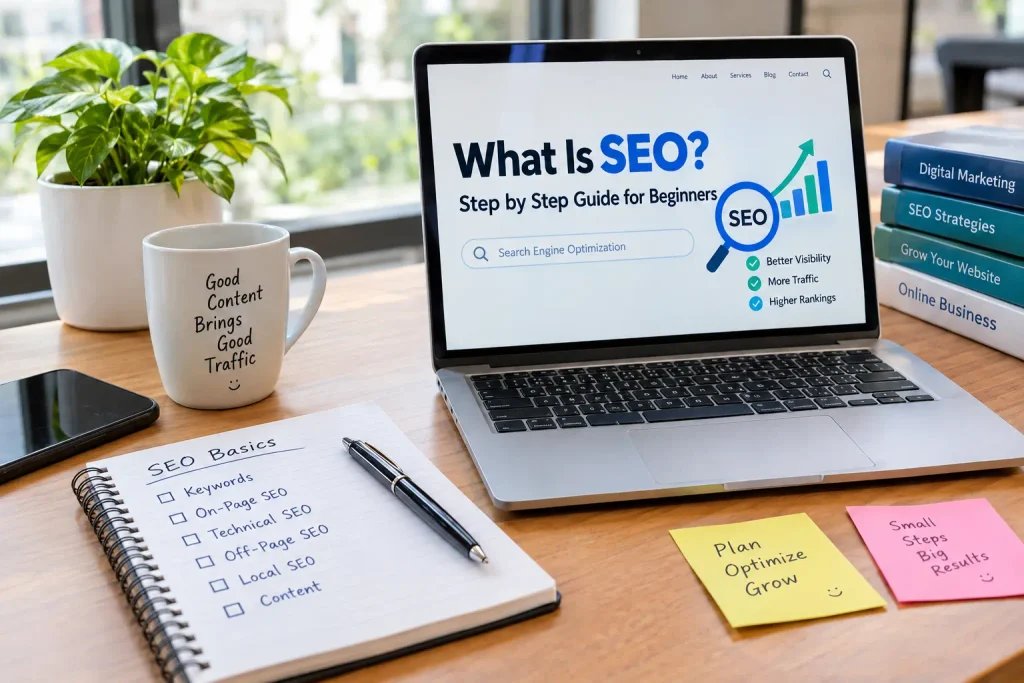
What Is SEO?
What Is SEO? Beginner’s Guide, If you have a website, blog, or online business, you have probably heard the term SEO.
But what is SEO, and why does it matter?
SEO stands for Search Engine Optimization. In simple terms, SEO helps a website become easier to find when people search for related information, products, or services on search engines such as Google.
For example, imagine that you run a digital marketing institute. Someone searches for “digital marketing course near me.” If your website is properly optimized and relevant to that search, it may appear in the search results.
That is the basic idea behind SEO.
However, SEO is not just about adding keywords to a website. It is about understanding what people search for, creating useful content, and making the website easy to use.
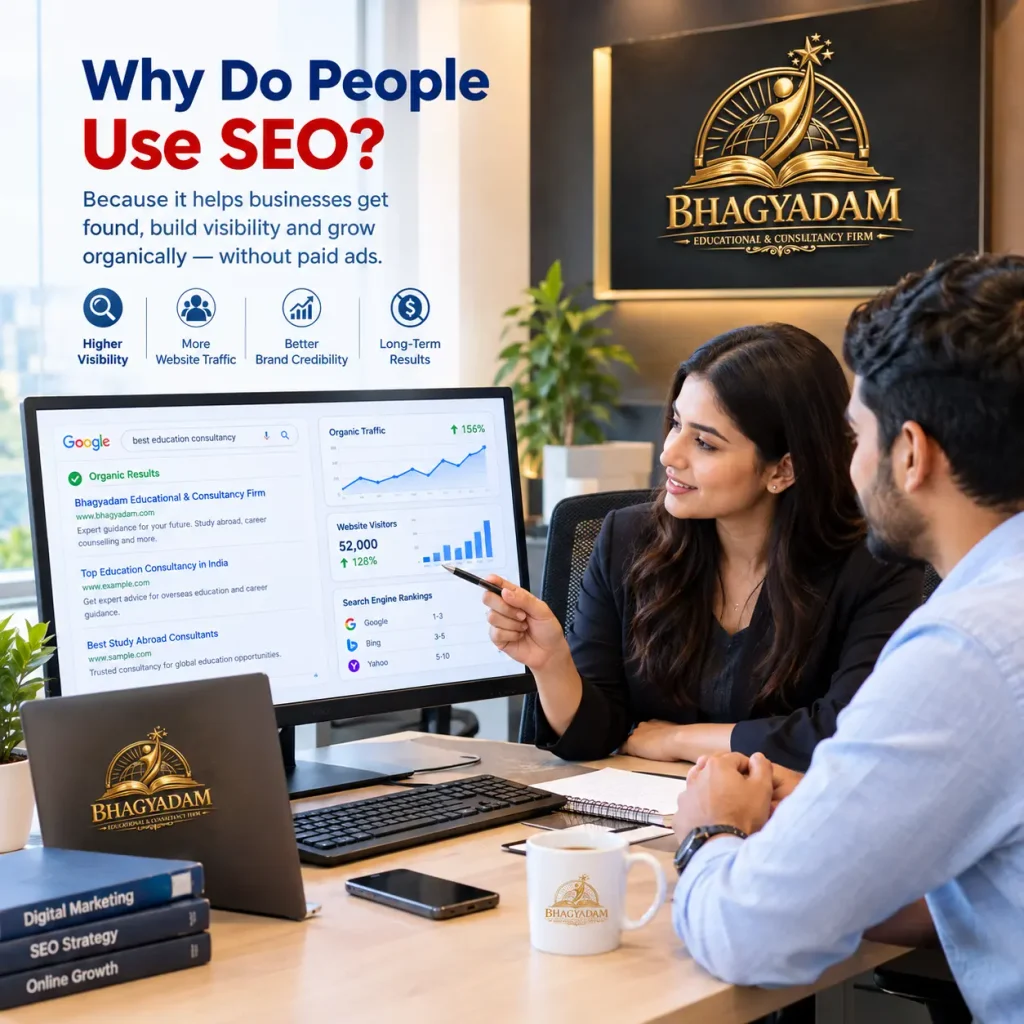
Why Do People Use SEO?
Think about how you normally find something online.
You open Google, type your question, and look through the results. You usually do not know which website will appear before you search.
For businesses, this creates a simple challenge:
How can people find your website when they are already looking for what you offer?
SEO is one way to work toward that goal.
A good SEO strategy can help a website:
- Reach people through organic search
- Attract visitors interested in its topic
- Build online visibility
- Bring attention to products or services
- Create opportunities for leads and enquiries
- Grow its search presence over time
SEO is especially useful when a business wants to build a steady source of website traffic instead of depending only on paid advertisements.
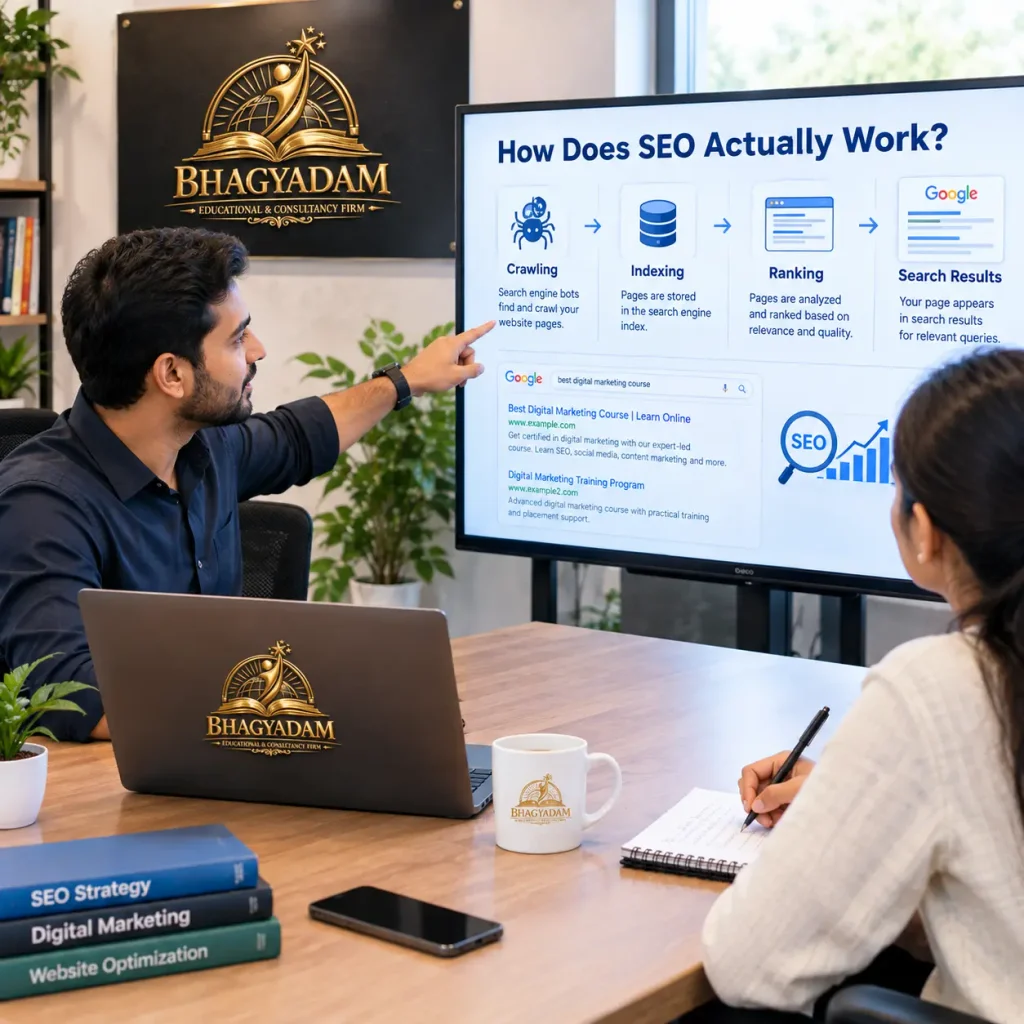
How Does SEO Actually Work?
Search engines have a huge amount of information to organize.
When someone searches for something, the search engine tries to find pages that are relevant to that query and useful for the person searching.
To do this, search engines need to understand webpages.
This is where SEO comes in.
A well-optimized website gives clear signals about its content. Its pages are organized properly, the information is relevant, and visitors can use the website without unnecessary difficulty.
You can think of SEO as helping both sides:
Search engines understand your website.
Good SEO should support both.
People understand and use your website.
What Are Keywords in SEO?

Keywords are the words and phrases people type into search engines.
For example, someone interested in learning SEO might search for: What Is SEO? Step by Step Guide for Beginners
- SEO course for beginners
- how to learn SEO
- SEO basics
- what is SEO in digital marketing
These searches tell us something important: people are looking for information.
Keyword research helps you discover these search terms and understand what your audience wants.
But there is one mistake beginners often make.
They find a keyword and then repeat it again and again throughout the article.
That is not the purpose of keyword research.
The keyword should help you understand the topic. Your content should then answer the user’s question naturally.
What Is Search Intent?

Search intent simply means the reason behind a search.
Consider these two searches:
“What is SEO?”
“Best SEO tools for beginners”
The first person wants to understand SEO.
The second person is probably looking for tools.
Both searches contain the word SEO, but the users want different things.
Understanding this difference can make your content much more useful.
Before writing a page, ask yourself:
What does the person searching this phrase actually want?
Once you understand that, it becomes easier to decide what information your page should provide.
What Is On-Page SEO?

On-page SEO covers the parts of a webpage that you can directly improve.
This includes things such as:
- Page title
- Main heading
- Subheadings
- Written content
- Internal links
- Images
- URLs
- Meta description
For example, if your article is about SEO for beginners, the title should make that clear.
The headings should also help the reader understand what comes next.
Good on-page SEO is not about making a page complicated. It is about making the page clear, organized, and useful.
What Is Technical SEO?

Technical SEO deals with the technical side of your website.
You may have excellent content, but that content will not provide a good experience if your website is extremely slow or difficult to use on a phone.
Technical SEO can include:
- Improving page speed
- Making pages mobile-friendly
- Fixing broken links
- Improving website structure
- Managing redirects
- Creating XML sitemaps
- Making important pages accessible to search engines
You do not need to become a developer to understand the basics.
The simple goal is to make sure your website works properly and can be accessed and understood by both users and search engines.
What Is Off-Page SEO?

Off-page SEO refers to activities that happen outside your own website.
One common example is getting links from other relevant websites.
Suppose you publish a detailed article about digital marketing. Another relevant website finds the article useful and links to it.
That link can become a signal about your website’s presence and relevance.
Off-page SEO may involve:
- Relevant backlinks
- Brand mentions
- Content promotion
- Digital PR
- Industry relationships
The important word here is relevant.
Getting hundreds of unrelated links is not the same as earning useful references from websites connected to your topic.
What Is Local SEO?
Local SEO is useful when a business serves customers in a particular location.
For example:
- A dental clinic
- A restaurant
- A salon
- A coaching centre
- A local repair service
A customer might search for:
“dentist in Gurgaon”
or
“best salon near me.”
In these situations, location becomes an important part of the search.
Local SEO can include accurate business information, local content, customer reviews, and a properly maintained business profile.
The goal is simple: help people discover a relevant local business when they are searching for its products or services.
Why Does Content Matter in SEO?
Content is one of the main ways a website provides information to its visitors.
But publishing a long article does not automatically make it good SEO content.
Imagine searching for “What Is SEO?” and opening an article that takes five paragraphs to answer the basic question.
You would probably want a clearer explanation.
That is why good SEO content should get to the point and then provide useful details.
A helpful article can include:
- A direct answer
- Simple explanations
- Relevant examples
- Clear headings
- Practical information
- Answers to common questions
The reader should finish the page feeling that their question was actually answered.
How Long Does SEO Take?
This is one of the most common SEO questions.
The honest answer is: there is no fixed timeline.
A new website and an established website do not start from the same position. Competition also varies from one topic to another.
SEO results can be influenced by factors such as:
- Website history
- Competition
- Content quality
- Technical condition
- Search demand
- Website structure
- Consistency
This is why SEO should be treated as an ongoing process.
You publish content, study the results, find areas that need improvement, and continue making changes.
SEO vs Paid Advertising
SEO and paid advertising can both bring visitors to a website, but they work differently.
With SEO, you work on improving organic visibility in search results.
With paid advertising, you pay to display advertisements to a selected audience or for particular searches.
For example, Google Ads can provide paid visibility, while SEO focuses on organic search presence.
Many businesses use both approaches because they can serve different marketing goals.
Can Beginners Learn SEO?
Absolutely.
You do not need advanced technical knowledge to start learning SEO.
A beginner can start with these basics:
First: Understand how search engines work.
Next: Learn keywords and search intent.
Then: Study on-page SEO and content optimization.
After that: Learn technical and off-page SEO basics.
Finally: Practice everything on a real website.
Frequently Asked Questions
Ans. SEO is the process of improving a website so that people can discover its relevant pages through search engines.
Ans. Organic search traffic is different from paid advertising, so you do not pay a search engine for every organic click. However, SEO can still require money for tools, content, website improvements, or professional services.
Ans. Yes. Keywords can help you understand what people search for. But they should be used naturally rather than repeated unnecessarily.
Ans. Yes. Beginners can learn many important SEO concepts without coding. Technical knowledge becomes more useful as you move toward advanced SEO work.
People Also Search
Meta Ads for Beginners: A Step-by-Step Guide
Leave a Reply