

Learn Python from Scratch: Complete Beginner’s Guide
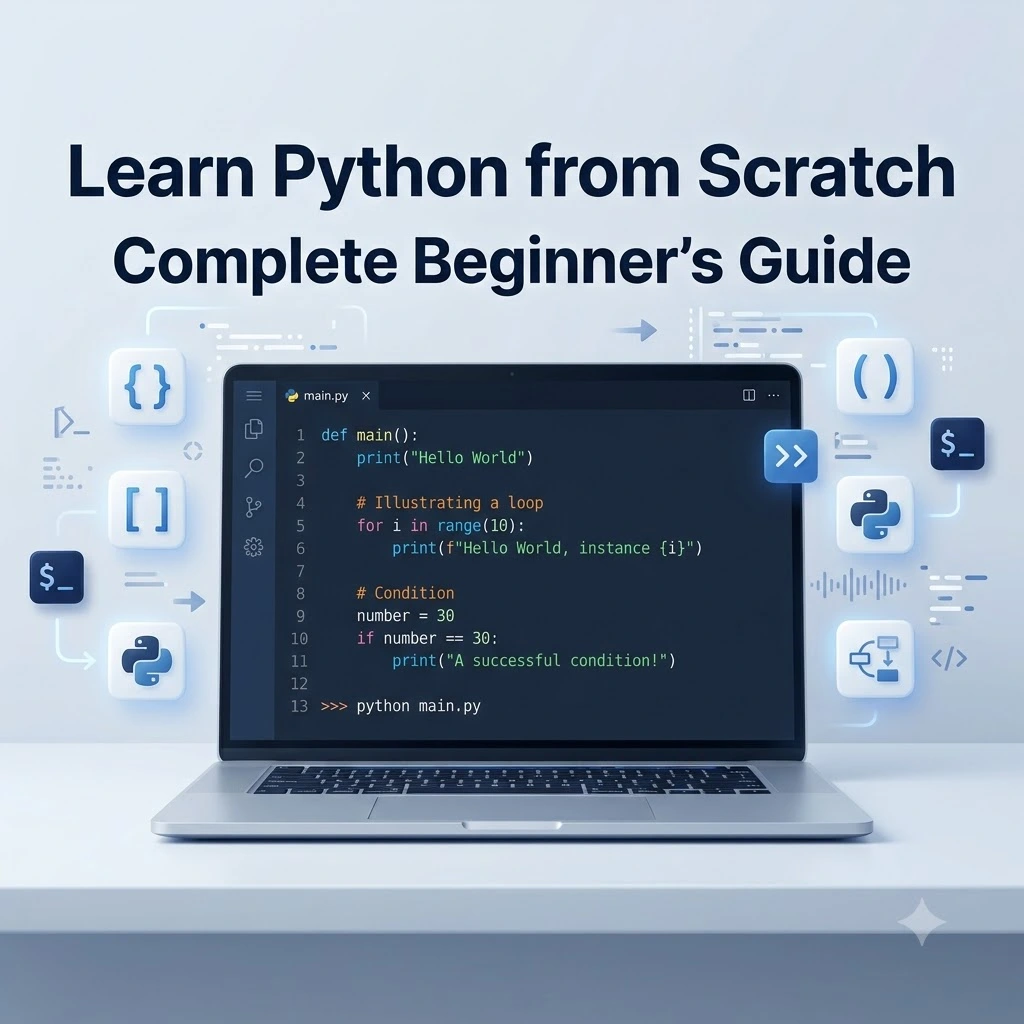
Python for Beginners: A Simple Guide, Learning to code becomes easier when you have a clear goal.
You do not need to start with complicated programming concepts. Begin with simple tasks. Then, gradually learn how computers follow instructions.
Python is a popular programming language. It is used for many types of technology projects.
Developers use Python for:
- Web development
- Automation
- Data processing
- Scientific computing
- Software development
- Artificial intelligence
One of Python’s biggest advantages is its readable syntax. This makes it easier for beginners to understand code.
If you are new to programming, you do not need to learn everything at once. Start with the basics, practise regularly, and build small projects.
What Is P Python is a high-level, general-purpose programming language.
In simple words, Python lets you write instructions that a computer can execute.
For example:
name = "Amit"
print(name)
The first line stores information in a variable. The second line displays that information.
This simple example teaches an important programming concept: storing and using information.
As you learn more Python, you can combine simple instructions to perform more complex tasks.
Why Is Python Popular?
Python is popular because it can be used for many different types of programming work.
For example, developers can use Python to build web applications. Data professionals can use it to process and analyse information.
Python also has a large ecosystem of libraries and frameworks. These tools provide ready-to-use functionality and can save development time.
Python is useful for both learning programming and building practical applications.
However, learning Python still requires practice. You need to understand programming concepts and spend time writing and testing code.
What Is Python Used For?
Python is used in many areas of technology.
Web Development
Python can be used to build websites and web applications.
Frameworks such as Django and Flask provide tools for developing web-based projects.
Automation
Python can automate repetitive computer tasks.
For example, a Python script can help you:
- Process files
- Organise information
- Perform repeated calculations
- Complete routine tasks
Automation can save time and reduce repetitive manual work.
Data Analysis
Python is useful for working with datasets and analysing information.
It can help professionals work with:
- Business data
- Reports
- Statistics
- Structured information
Artificial Intelligence
Python is widely used in artificial intelligence and machine learning.
However, beginners should first learn Python fundamentals before moving into advanced AI topics.
A strong foundation makes advanced concepts easier to understand.
Software Development
Python can also be used to create different types of software and supporting tools.
Its flexibility allows developers to use it for projects with different requirements.
Python Basics Every Beginner Should Know
You do not need to start with advanced programming concepts.
First, build a strong foundation in the basics.
Important Python concepts include:
- Variables
- Data types
- If-else statements
- Loops
- Functions
- Lists
- Dictionaries
Variables
Variables are used to store information in a program.
For example:
student_name = "Neha"
marks = 78
The stored values can be used later in the program.
Variables make it easier to work with information inside your code.
Data Types
Python works with different types of values.
These include:
- Text
- Numbers
- Boolean values
- Collections
Understanding data types helps you know how different types of information can be used in a program.
If-Else Statements
Programs often need to make decisions.
Python uses if-else statements to check conditions.
For example:
age = 20

if age >= 18:
    print("Adult")
else:
    print("Minor")
The program checks the condition and displays the appropriate result.
Loops
A loop allows a program to repeat an operation.
For example, if you need to process several items, a loop can perform the same type of task without requiring you to write the same instruction repeatedly.
Loops are useful when working with repeated tasks.
Functions
Functions help organise code into separate and reusable sections.
As programs become larger, functions can make your code easier to understand and maintain.
They also allow you to reuse the same logic in different parts of a program.
Lists and Dictionaries
Programs often need to store multiple pieces of information.
Python provides data structures such as lists and dictionaries for organising and accessing information.
Learning these structures is an important part of Python programming.
How Does Python Help Solve Real-World Problems?
Programming becomes more meaningful when you connect it to a real problem.
Imagine that a small business owner wants to calculate the total value of daily sales.
Instead of calculating every amount manually, Python can process the numbers.
For example:
sales = [1200, 850, 1450, 920]

total = sum(sales)

print(total)
The program adds the sales values and displays the total.
This is a simple example, but it shows how Python can turn a repetitive calculation into a quick process.
The same idea can be used for larger and more complex tasks.
What Should You Build While Learning Python?
Practice becomes more useful when you create something instead of only reading tutorials.
Beginners can start with small Python projects such as:
- Calculator
- Student marks calculator
- Simple quiz
- Expense tracker
- Number guessing game
- To-do list
- Contact book
- File organiser
Choose a project that you understand.
For example, if you regularly track your expenses, you could create a simple expense tracker.
Because you already understand the problem, you can focus on learning how to solve it using Python.
What Are Python Libraries?
A Python library is a collection of ready-to-use code.
Libraries help developers perform specific tasks without building everything from scratch.
Python has libraries and frameworks for areas such as:
- Web development
- Data processing
- Scientific computing
- Machine learning
Learning libraries becomes more useful after you understand the core Python concepts.
First, learn how Python works.
Then, learn which tools can help you complete your specific task.
What Should You Do When Your Python Code Has an Error?
Errors are a normal part of programming.
Even experienced developers encounter errors.
A beginner may see an error because of:
- Incorrect spelling
- Missing punctuation
- Wrong indentation
- Incorrect variable names
- Unexpected data
- Problems in program logic
When an error appears, do not immediately rewrite the entire program.
First, read the error message.
Then, check the line mentioned by Python.
Try to understand what the program expected and what it actually received.
Make one change and test the program again.
This process is called debugging. It is an important programming skill.
How Should Beginners Learn Python?
A simple learning routine can make learning Python easier.
Start With the Fundamentals
Begin with:
- Variables
- Data types
- Operators
- Conditions
- Loops
- Functions
- Basic data structures
Do not rush into advanced topics.
Write Small Examples
After learning a concept, create a small program using it.
This helps you understand how the concept works in practice.
Practise Without Copying Everything
Reading examples is useful.
However, writing your own version gives you better practice.
Try changing:
- Values
- Conditions
- Output
- Program logic
Then observe what happens.
Build a Small Project
Once you understand the basics, combine different concepts in one project.
This is where Python starts to become more practical.
Choose a Specialisation
After learning the fundamentals, choose an area that interests you.
You can explore:
- Web development
- Automation
- Data analysis
- Software development
- Artificial intelligence
- Machine learning
You do not need to choose your specialisation on the first day.
Can Students Learn Python?
Yes.
Python can be a useful starting point for students who want to develop programming skills.
Students can begin with simple programs and gradually move toward larger projects.
The important thing is regular practice.
Instead of trying to memorise every example, understand why the program produces a particular result.
Can Beginners From Non-Technical Backgrounds Learn Python?
Yes.
Previous programming experience can make some topics easier, but it is not essential.
A non-technical learner can start with simple concepts and gradually build confidence through practice.
The first few weeks may involve many mistakes.
That is normal.
Programming skills develop through solving problems, testing ideas, and learning from errors.
How Long Does It Take to Learn Python?
There is no fixed answer.
Learning basic Python syntax and becoming capable of developing complete applications are two different goals.
Your learning time depends on:
- How regularly you practise
- Your previous experience
- The type of projects you want to create
Instead of setting a strict deadline, set practical milestones.
For example:
First milestone: Write basic Python programs.
Second milestone: Use conditions, loops, and functions.
Third milestone: Complete a small project.
Fourth milestone: Work with Python libraries.
Fifth milestone: Create a project related to your chosen field.
This approach makes your progress easier to measure.
A Simple Python Learning Path
Beginners can follow this learning path:
Python Fundamentals
↓
Programming Logic
↓
Small Coding Exercises
↓
Beginner Projects
↓
Libraries and Tools
↓
Specialised Learning
↓
Real-World Projects
The exact learning speed can vary from person to person.
The important thing is to understand each stage before moving to the next one.
Frequently Asked Questions About Python
Ans. Yes.
Python has readable syntax and can be used in many areas. This makes it a practical starting point for people who are new to programming.
Ans No.
You can start learning Python even if you have never written code before.
Begin with basic programming concepts and practise regularly.
Ans.Yes.
Python is open-source and can be used without purchasing the programming language.
Ans. You can create many types of projects with Python, including:
Automation scripts
Software tools
Web applications
Data projects
Games
Small programs
People Also Search :-
Leave a Reply